Repository navigation
Give state hints when the state set or methods come from the receiver's supertypes - #464
Conversation


|
[Codex review] The inherited-method machine can suggest a call the receiver cannot make. Reproducer on this PR head: |

…unknown (#458) Part of #454 (part (a): what the hint suggests when any state is possible, and how hints name states). Part (b), suggesting a check such as `canRedo()`, needs return-value queries modelled as guards. That is a separate change. ## Problem When the receiver's state is unknown, the hint has two problems: 1. It suggests transitions whose own precondition is just as unknown. In the issue, `redo()` needs `redoable`, and the hint suggests `undo()`, which needs `undoable`. Following it only moves the error to `undo()`. 2. It names states in every combination with state sets the call does not check: "undoable and redoable or notUndoable and redoable", and six combinations with the study's three-set spec. Hints for partly known states do the same ("No sequence of calls moves this from <6 combinations> to <6 combinations>"). Before (the issue's JabRef exercise in VS Code): 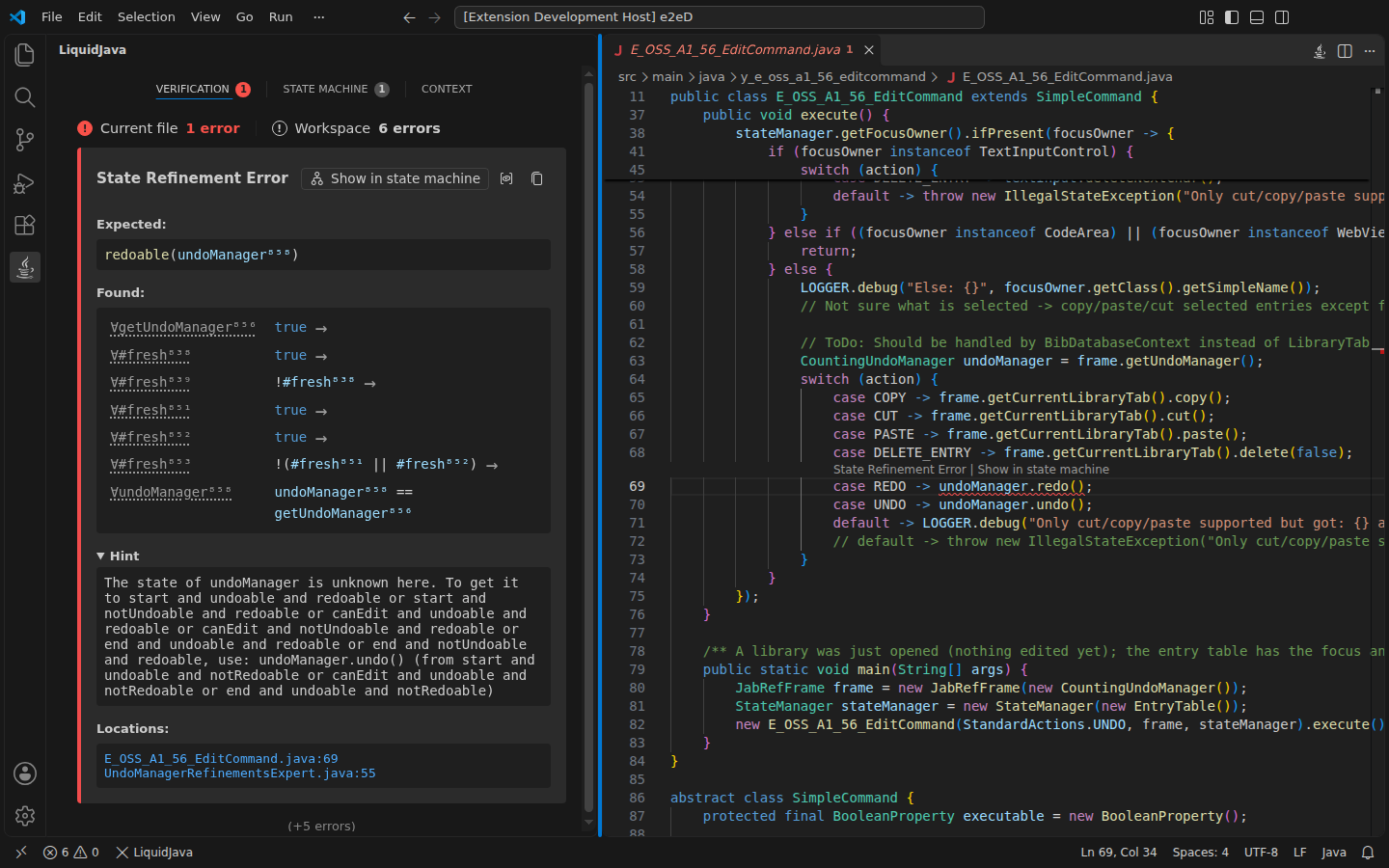 ## Cause `StateHints.reachingCalls` listed every transition from a state that does not allow the call into one that does (`StateMachine.transitionsEnabling`), whatever its `from`. All hints printed a set of states by joining each state's names in every state set. ## Fix - **States are named briefly, everywhere.** `StateMachine.describe` (new `StateCover`) names a set of states as the fewest groups that each fix the state in some state sets and allow any state in the others: a smallest cover by maximal sub-products of the state sets. It works on the machine's solver-built states, with no string matching. Every state hint uses it, for the current, needed and reached states. For example: - `redoable(this)` with three state sets reads `redoable`; - `closed(this) && unlocked(this)` reads `closed and unlocked`; - `open(this) || loud(this)` across two sets reads `open or loud`; - two refinements `from = "undoable(this)"` and `from = "redoable(this)"` read `undoable or redoable`; - a receiver known only to be `notRedoable` reads `notRedoable`. The receiver's current state is named in every state set the call checks, plus any set its states agree on. So a join that differs in a checked set still lists each state (`closed and unlocked or opened and unlocked`), and one that differs only in an unchecked set does not (`closed`). A single fully known state reads as before (`closed and locked`). When every state allows the call, each by its own refinement, the needed state is named per refinement (`a or b`, not every state). - **Only calls that work from any state.** When any state is possible, the hint reuses the call sequence search of the known-state case, starting from every state. A call is suggested only if it is allowed in every state. That covers transitions with no `from` and sequences that start with one (`reset(), then open()`). Same limits as before: at most 3 sequences of at most 3 calls. - **The needed state is always named.** The `NEEDED_STATE` hint (renamed from `REACHING_CALLS`, which nothing in vscode-liquidjava or liquidjava-mcp uses) always names the state the call needs, plus the constructors that create an object in it. That includes a call that every state allows, each by a different refinement (a toggle). Constructors are not suggested when the receiver is `this`. The same applies to the existing "Create a new object instead" hint. - **Only constructors that can be called.** `StateMachineBuilder` leaves out the constructors of abstract classes and interfaces (`abstractType`, as in #464), enums, and private constructors, so no hint suggests `new` for them. - **A failed check is not "unknown".** In `if (!it.hasNext()) it.next();`, the receiver's own refinement says nothing, but the error's found (`(#fresh == true --> hasMore(it)) && !#fresh`) mentions its state through the check's result. `StateErrorCategories.checkedElsewhere` looks at what the error shows as found (`TypeChecker.shownFound`, the same premise chain the error prints). It only computes that when every state is possible and the receiver's own refinement mentions none. It counts a state only if it is applied to the receiver's instance, or to an object the solver proves equal to it (`Scanner same = it; if (!it.hasNext()) same.next();`). A check on another object (`if (other.hasNext()) it.next();`, or the "checked the wrong object" `if (it.hasNext()) other.next();`) leaves the state unknown. When it does count, the category is none instead of UNKNOWN, and the hint reads "What is known here does not decide the state of it, and this call needs it to be hasMore". Joins of every state across several state sets (`if (p) d.open(); if (q) d.lock(); d.enter();`) are not checks. They keep main's category (none) and main's "No sequence of calls moves d from … Create a new object instead" hint. - **What changes outside the unknown case:** - The only category change is UNKNOWN to none for a failed check on the receiver itself (`iterator_observer_error`, `state_test_method_error`). - Known-state hints change in two ways. States are named more briefly, as above. The constructor suggestions also go away for `this` receivers and for abstract classes, interfaces, enums and private constructors (in "Create a new object instead with …"). - `StateMachineBuilder` now leaves those constructors out of the machine. `canModel` and the methods it admits are unchanged. **Extension point for part (b).** `StateHints.anyState` builds the hints for "any state is possible": the needed state, then the call sequences from any state. It already tells the two causes apart: nothing known, or a check that did not decide the state. A guard hint goes between the two hints, once the machine records queries whose return value decides a state set. For example: "Check `undoManager.canRedo()` before this call", or for a failed check, "Call `it.next()` only when `it.hasNext()` returns true". **Clean-code pass** (878738a, no change in any hint: all 84 state fixtures and 30 reviewer reproducers print the same hints before and after): - `StateCover` searches for the smallest cover exactly, with no greedy fallback, and keeps each group's states with it. - `StateHints` takes the needed states from one source, and names the checked state sets (`checkedSets`) and the check flag (`checkedElsewhere`) apart. - `StateErrorCategories` shares its "every state possible, none mentioned" test. - `StateMachine.statesAllowing` is derived from `statesAllowingByRefinement`. - `AuxStateHandler` only looks for a check when no argument decided the state. ## Hint output, before (main) and after **Issue reproducer** (external `UndoManager` spec, two state sets, receiver from a method return): ``` before: The state of undoManager is unknown here. To get it to undoable and redoable or notUndoable and redoable, use: undoManager.undo() (from undoable and notRedoable) after: The state of undoManager is unknown here, and this call needs it to be redoable ``` **Three state sets** (parameter receiver): ``` before: The state of history is unknown here. To get it to start and undoable and redoable or start and notUndoable and redoable or canEdit and undoable and redoable or canEdit and notUndoable and redoable or end and undoable and redoable or end and notUndoable and redoable, use: history.undo() (from start and undoable and notRedoable or canEdit and undoable and notRedoable or end and undoable and notRedoable) after: The state of history is unknown here, and this call needs it to be redoable ``` **Disjunction across state sets** (`from = "open(this) || loud(this)"`) and **one refinement per set** (`undoOrRedo()`): ``` before: No state information is known for this object. Make sure its state is initialized and available at this point. after: The state of s is unknown here, and this call needs it to be open or loud after: The state of history is unknown here, and this call needs it to be undoable or redoable ``` **A failed check** (`if (!it.hasNext()) it.next();`): ``` before: (no hint) after: What is known here does not decide the state of it, and this call needs it to be hasMore ``` **A call allowed in any state** (`reset()` has no `from`; `open()` needs `created`): ``` before: The state of f is unknown here. To get it to open, use: f.open() (from created) after: The state of f is unknown here, and this call needs it to be open Call f.reset(), then f.open() before this call to move f from any state to open ``` **Partly known state** (`this` known to be `notRedoable`, three state sets): ``` before: No sequence of calls moves this from start and undoable and notRedoable or start and notUndoable and notRedoable or canEdit and undoable and notRedoable or canEdit and notUndoable and notRedoable or end and undoable and notRedoable or end and notUndoable and notRedoable to start and undoable and redoable or ... (6 combinations) In state start and undoable and notRedoable or ... (6 combinations), this can call: check() after: No sequence of calls moves this from notRedoable to redoable In state notRedoable, this can call: check() ``` **Toggle** (a class whose `flip()` goes from `up` to `down` and back): ``` before: The state of t is unknown here. To get it to up or down, use: new ErrorStateHintUnknownToggle() after: The state of t is unknown here, and this call needs it to be up or down. Objects created with new ErrorStateHintUnknownToggle() start in such a state ``` **Known state, unchanged** (after `open(); close();`): ``` Call f.reset(), then f.open() before this call to move f from closed to open In state closed, f can call: reset() ``` **Every other state fixture.** I ran each `Error*` state fixture and test-suite directory on main and on this branch and compared the hints. Apart from the cases above, the only changes are: - every "unknown" hint now has the new wording; - `iterator_observer_error` and `resultset_forward_error` (line 67) now get the needed-state hint. On main they got the generic "No state information is known…" hint, or no hint after a failed `hasNext()`; - `state_test_method_error` (`if (edit.canUndo()) {} else edit.undo();`) now reads "What is known here does not decide the state of edit…" instead of "unknown", and no longer suggests `edit.redo()`; - `ErrorLoopPostState` no longer suggests `new ErrorLoopPostState()` for `this`; - `ErrorPathDependentOtherStateSet` now reads "from closed to opened" instead of two combinations each. **Merging with #464.** Both PRs touch `StateMachineBuilder` and `StateHints`, and the conflicts are mechanical: - keep one `abstractType`: both PRs add an identical one; - move #464's `.distinct()` on the constructor lists into `StateHints.newObjects`, which replaces both lists here; - merge this PR's `typeName` (in `privateConstructor`) with #464's `parameterTypes`, which do the same thing. ## Tests Each test pins one behaviour. To keep CI fast, the fixtures are grouped so that one verifier run checks several errors. Every new test fails without its fix: on the PR's base, or on the commit before the fix it pins. | Test (`TestStateHints`) | Fixture | Pins | |---|---|---| | `unknownStateOfAnExternalClassNamesOnlyTheCheckedStateSet` | `classes/state_hint_undo_manager_error` | the issue reproducer: needs `redoable`, `undo()` not suggested | | `unknownStateDoesNotSuggestACallThatNeedsAnotherUnknownState` | `ErrorStateHintUnknownState` (existing, expectation changed) | a call that needs another unknown state is not suggested | | `unknownStateSuggestsCallsAllowedInAnyState` | `ErrorStateHintUnknownAnyState` | `reset(), then open()` is suggested; `open()` alone is not | | `statesAreNamedOnlyInTheStateSetsThatMatter` | `ErrorStateHintNaming` (3 errors) | `open or loud` across sets; a toggle on `{a, b} × {x, y, z}` reads `a or b`; a partly known state reads `notRedoable` | | `failedCheckOfTheReceiverIsNotAnUnknownState` | `classes/state_hint_checked_error` (3 errors) | a failed `hasNext()` on the receiver, or on a variable holding it, "does not decide", with no category; a check of another scanner leaves it unknown (UNKNOWN) | | `joinsAreNotTakenForAnUnknownState` | `ErrorStateHintJoins` (2 errors) | a join of every state of two sets keeps main's "No sequence of calls" hint, with no category; a join in one checked set lists both states | | `onlyConstructorsThatCanBeCalledAreSuggested` | `ErrorStateHintConstructors` (4 errors) | a concrete class's constructor is suggested; none for `this`, an abstract class or a private constructor | `StateMachineTest` has 10 unit tests for `describe` and `stateSetsNamed`. They run in milliseconds and cover the state naming: one set, cross-set and three-set disjunctions, every state, forced sets, and declaration order. Removed as overlapping: separate fixtures for three state sets, a one-set disjunction, one refinement per set, a two-set goal, a field receiver, several and long sequences, the one-set toggle, a known state, and the external abstract and interface specs. Each is covered by one of the tests above, by an existing test or by the unit tests. The interface spec never reached the guard, since an interface cannot declare a constructor refinement. **Test time** (`mvn test` for the verifier, two interleaved runs of each on the same machine, surefire time summed over test cases): | | tests | surefire | wall | `TestExamples` | `TestStateHints` | |---|---|---|---|---|---| | base (0053074) | 547 | 81.9 s | 89.1 s | 64.8 s | 2.2 s | | PR before trimming (b9683e9) | 613 | 98.6 s (+16.7) | 106.0 s (+16.9) | 72.2 s | 9.7 s | | PR now | 569 | 88.2 s (+6.3) | 95.2 s (+6.1) | 67.3 s | 5.3 s | `mvn test` for the verifier: **569 tests, 0 failures, 0 errors**. 🤖 Generated with [Claude Code](https://claude.com/claude-code) --------- Co-authored-by: Claude Opus 5.5 <noreply@anthropic.com>


…'s supertypes

Co-Authored-By: Claude Opus 5.5 <noreply@anthropic.com>
…-named classes

Co-Authored-By: Claude Opus 5.5 <noreply@anthropic.com>
Co-Authored-By: Claude Opus 5.5 <noreply@anthropic.com>
A private method is not inherited, nor is a package-private one by a class in
another package, so suggesting it gives a call that does not compile. Such
methods leave the machine incomplete instead.

Co-Authored-By: Claude Opus 5.5 <noreply@anthropic.com>

fc7acd4 to
86e7ded
Compare
|
[Claude] Rebased onto main, which now has #458, #459 and #460, and addressed the Codex review. Rebase. The conflicts in
Codex: inaccessible inherited methods (86e7ded). An inherited method now joins the receiver's machine only if the receiver's class inherits it. A private method never counts, and a package-private one counts only when the subclass is in the same package. Any other method is left out and marks the machine incomplete, so the hints don't claim that no sequence exists. Interface methods always count. New fixture: The full suite passes locally ( |
|
[Codex review] Protected inherited methods are still suggested from unrelated callers. Example: |
The machine is shared by every caller, so a protected or package-private
method is left out as well: some callers cannot call it.

Co-Authored-By: Claude Opus 5.5 <noreply@anthropic.com>
|
[Claude] Codex is right, and the package-private rule from 86e7ded had the same hole. Whether such a call compiles depends on where the caller is, not on the subclass's package. The machine is built once per class and shared by every caller ( Fixed in 2f97168: an inherited method joins the receiver's machine only if it is public, or declared in an interface. Private, package-private and protected methods are left out, and the machine is marked incomplete, so the hints say "(and possibly others)" and never claim that no sequence exists. A caller that could reach such a method loses that suggestion, but every suggested call now compiles from any caller. The fixture |
|
[Codex re-review] The public-only filter still admits private interface methods: |
Co-Authored-By: Claude Opus 5.5 <noreply@anthropic.com>
|
[Claude] Fixed in 343c7f6. Interface methods are no longer accepted wholesale: a method declared in an interface counts unless it is private (the others are implicitly public), and a method declared in a class must be public. New case in the same fixture, |
|
[Codex re-review] The latest update filters private interface methods and adds a fixture covering the case. I found no further issue in this change; CI is green. |
…by name and arity

Co-Authored-By: Claude Opus 5.5 <noreply@anthropic.com>
|
[Claude] Ran /clean-code-principles on this PR. Applied in 20e7a45 (no change in behaviour; the full suite passed on the change before a final rename-only tidy, and
Skipped:
Tests: the 9 new |


Fixes #456.
State hints come from a state machine. Until now, that machine was built only from the class the failing method is specified for. When the
@StateSetis in a superclass's spec (Window) and the method is in a subclass's spec (Frame), the machine had no states, so the error had no hints.The machine is now built for the receiver's static type. It includes the state sets of that type and of all its supertypes, and the refinements a call on that type actually uses, matching how the verifier picks them: the receiver type's own refinement first, otherwise the one for the nearest type that declares the method. If it can't tell which refinement the verifier applies, it leaves the method out and marks the machine incomplete, so hints never suggest a call that wouldn't verify and never claim "no sequence of calls" when unsure.
Issue example, after the change:
Cases covered (
TestStateHints)Window's spec, method inFrame's spec (the issue)Call host.dispose() …,can call: dispose(), pack()JFramereceiver with no spec of its own (grandchild)windowFrameredeclaresaddNotifyin its bytecode,Window's spec refines itaddNotify()not suggested,(and possibly others)Call s.bc() …(no hints before)Call s.next() … from a to cStackspec refinesadd(E), whichStackinherits fromVectorCollectionnext to anArrayListspecOther changes
AuxHierarchyRefinementsPassage.transferStateRefinementsindexed the method's parameters with the index of the state refinement, so overriding a parameterless state-refined method crashed withIndexOutOfBoundsException. The method itself is now the placement element. This is only part of Crash when an override has fewer state refinements than the method it overrides #462, which is still open.*error*fixtures against main. Eight changed, all for the better: no more suggestions likenew Throwable(String)for anException-typed receiver (it wouldn't type-check), and new "No sequence of calls" hints where they're true.Not in this PR
Ghost … could not be foundif it's read before its superclass's spec. The fixture keeps both interfaces in one file,Windowfirst, as in the issue.Testing
./mvnw -pl liquidjava-verifier test: 548 tests, 0 failures, run locally.🤖 Generated with Claude Code